

1. The Perimeter Thermal Bridge Problem in Traditional IGUs
In standard Insulated Glass Units (IGUs), two sheets of glass are separated by a hollow metallic spacer bar filled with desiccant beads. Historically, these spacers were manufactured from extruded aluminum. While aluminum is structurally rigid and easily bent, its high thermal conductivity creates a severe thermal highway around the entire perimeter of the glass.
This perimeter thermal bridge causes significant heat loss, drops the glass edge temperature by 5°C to 8°C, and results in persistent winter condensation and frost along the sightline edge. This localized heat flow is measured by the Linear Thermal Transmittance.
2. Warm Edge Spacer Engineering: Material Science & Design
Warm Edge Spacers are advanced composite spacer bars engineered from low-conductivity materials that reduce heat transfer at the glass edge by up to 85%
| Spacer Technology | Material Composition | Thermal Conductivity | Linear Transmittance |
|---|---|---|---|
| Traditional Aluminum Spacer | 100% Extruded Aluminum Alloy | 160.0 W/m·K (Extremely High) | 0.075 – 0.085 W/m·K |
| Stainless Steel Spacer | Thin-wall roll-formed stainless steel | 15.0 W/m·K (10x better than aluminum) | 0.050 – 0.055 W/m·K |
| Engineered Composite Warm Edge (e.g. Technoform TGI) | Polypropylene engineered polymer with thin stainless steel gas barrier foil. | 0.15 – 0.20 W/m·K (1,000x lower than aluminum) | 0.032 – 0.038 W/m·K |
| Structural Silicone Foam (e.g. Super Spacer) | Flexible open-cell silicone matrix with integrated desiccant and multi-layer vapor barrier. | 0.12 – 0.15 W/m·K | 0.028 – 0.032 W/m·K |
3. Thermodynamic Benefits: Elevating Sightline Temperatures & Whole-Window
Upgrading an IGU from a conventional aluminum spacer to an engineered composite warm edge spacer delivers immediate, measurable performance gains:
- Elevates Edge Temperature: Raises the internal perimeter glass sightline temperature by 4°C to 6°C, completely preventing perimeter condensation under normal indoor humidity.
- Improves Overall Window U-Value: Reduces the whole-window by 0.1 to 0.2 W/m²K across the entire assembly without changing the glass coating.
- Stress Relief on Glass: Flexible composite and silicone spacers absorb thermal expansion differences and wind pressure deflections between the inner and outer glass lites, dramatically reducing thermal stress fractures.
4. Dual-Seal Barrier Engineering & Long-Term Argon Gas Retention (EN 1279-3)
Modern high-performance IGUs are filled with 90%+ pure Argon gas, 34% more insulating than dry air). Maintaining this gas inside the cavity over a 30+ year lifespan requires a robust Dual-Seal Perimeter Barrier:
- Primary Seal (Polyisobutylene – PIB):
A non-curing, high-tack elastomeric butyl applied continuously to both sides of the spacer bar. PIB serves as an impermeable barrier against atmospheric moisture vapor ingress and prevents argon gas molecules from escaping. - Secondary Structural Seal (Polysulfide / Silicone / Polyurethane):
A high-modulus, two-component structural sealant applied behind the spacer bar. It provides structural mechanical adhesion holding the glass panes rigidly in place against wind load cycling and handling. - EN 1279-3 Certification: Certified dual-seal IGUs achieve an annual gas leakage rate of < 0.5% per year, guaranteeing that the IGU retains over 85% of its original insulating argon gas after 30 years of continuous service.
Frequently Asked Questions (FAQ) – Warm Edge & Argon Gas Technology
Q1: How do I know if my insulated glass windows have argon gas inside?
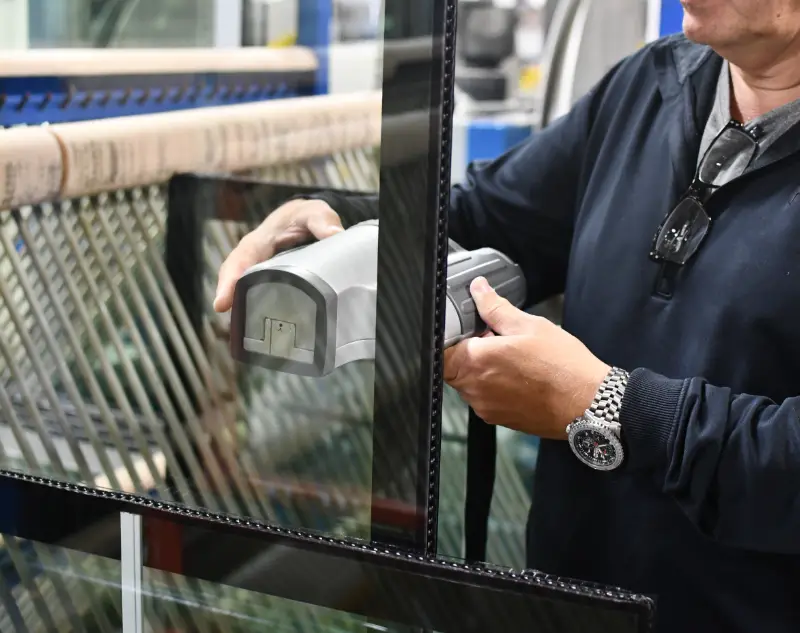
A1: Certified manufacturing facilities use non-destructive spark emission or high-frequency optical sensors (such as Sparklike laser meters) to verify 90%+ argon fill concentration on the production line without puncturing the glass unit.
Q2: Why is krypton gas used in some ultra-high performance windows instead of argon?
A2: Krypton gas has even lower thermal conductivity than argon and delivers peak thermal insulation in very narrow gas cavities (8mm–10mm). However, krypton is significantly more expensive and is primarily specified for ultra-slim historical restorations or ultra-demanding Passive House triple/quadruple glazing.
Q3: Can warm edge spacers bend around corners without cutting?
A3: Yes. Modern automated IGU manufacturing lines utilize robotic bending equipment that smoothly bends composite warm edge spacer profiles into continuous four-corner frames, eliminating corner keys and reducing potential gas leakage points from four to just one sealed joiner.
Q4: Does desiccant inside the spacer bar need to be refilled?
A4: No. High-capacity molecular sieve 3A desiccant matrix is sealed inside the spacer during factory assembly. It permanently adsorbs initial assembly moisture and any trace moisture vapor that enters over decades of service, keeping the cavity completely dry.